Wednesday, August 24, 2011

Peace amid Violence

The fifth in my series of excerpts from Zen Lessons: The Art of Leadership, following on Gain and Loss. This one struck me due to its seeming Stoicism. That school of philosophy always had some appeal for me. Zen ideas have taken slightly deeper root lately, now that I practice Danzan Ryu Jujitsu, a Japanese (by way of Hawai'i) martial art.

142. Peace Amid Violence

Zen Master Shantang fled to Yunmen hermitage along with Ministry president Han Zicang, Zen Master Wanan, and one or two other Zen adepts, to avoid the violence of a civil war in the early 1130's. Mr. Han asked Wanan, "Recently I heard you were captured by soldiers of the rebel leader Li Cheng. How did you contrive to escape?"
     Wanan said, "I had been captured and bound, and starved and froze for days on end, until I thought to myself that I would surely die. Then it happened that there was a snowfall so heavy that it buried the building and caused the walls of the rooms where we were held to collapse. That night over a hundred people were lucky enough to escape."
     Mr. Hand said, "At the time you were captured, how did you handle it?"
     Wanan did not reply. Mr. Han asked him again, pressing him for an answer.
     Wanan said, "How is this even enough to talk about? People like us study the Way: we take right for sustenance and have only death. What is there to fear?"
     Mr. Han nodded at this.
     So we know that our predecessors had immutable will, even in the midst of mortal calamity and trouble in the world.
Collection of the True Herdsman

I think I send this out to all the die-hard activists out there — the Way is hard, and at the end is only death. Accepting this will actually make us more effective, and better people.

Thursday, July 14, 2011

Gain and Loss

The fourth in my series of excerpts from Zen Lessons: The Art of Leadership, following on Too Late, Don't Rush and Being in the World Without Misery. I just love the timeless quality of these stories.

69. Gain and Loss

Lingyuan said to the Confucian sage Cheng Yi:
     Calamity can produce fortune, fortune can produce calamity. This is because when one is in situations of disaster and danger, one is earnest in taking thought for safety, and when one is deeply immersed in seeking out order, one is capable of seriousness and discretion — therefore good fortune is born, and it is fitting.
     When fortune produces calamity, it is because when living in tranquility people indulge their greed and laziness, and are mostly scornful and arrogant — therefore calamity is born.
     A sage said, "Having many difficulties perfects the will; having no difficulties ruins the being."
     Gain is the edge of loss, loss is the heart of gain. Therefore blessings cannot visit over and over again, one cannot always hope for gain. When you are in a fortunate situation and so consider calamity, then that fortune can be preserved; when you see gain and consider loss, then that gain will surely arrive.
     Therefore a superior person is one who when safe does not forget danger, and who in times of order does not forget about disorder.
a scroll

This is the primordial Transition story. What is he saying? In calamity — the failure of industrial society, as exemplified by peak oil, climate change, and the systemic economic crisis — is born fortune. Transitioners are those "deeply immersed in seeking out order", and by being so we plant the seed from which good fortune might arise.
     Our society has been brought to this stage by several generations of economic growth and a growing middle class, and many were falsely led to believe this new and unique condition would last indefinitely. They are the apathetic — those without difficulties, who lived in tranquil times, indulged their greed and laziness, and who remain scornful and arrogant. They heap calamity upon themselves, and others.
     The superior person does not forget danger, does not neglect the possibility of calamity — and therefore secures good fortune. That is who we must be.

Friday, July 8, 2011

Too Late

The third in my series of excerpts from Zen Lessons: The Art of Leadership, following on Don't Rush and Being in the World Without Misery. I should think the relevance is clear.

65. Too Late

Lingyuan said to the astronomer Huang:
     In ancient times someone said, "If there is fire at the bottom of a pile of brush on top of which you are reclining, as long as the fire has not reached you, you are sure it is safe."
     This truly describes the workings of safety and danger, the principle of life and death. It is as clear as the sun in the sky, it does not admit of the slightest deviation.
     People usually stay in their accustomed situations, rarely reflecting on the calamities of life and death. One day something will come up that they cannot fathom, and then they will sit down and beat their breasts, but all will be helpless to come to the rescue.
a hanging scroll

Some commentary:
Once again, the proof is in this 1,000 year-old document: the human condition is eternal. Since we're not likely to change that, aside from selling our genes to Monsanto (new human condition: "mmm, GE soylent green is soooo tasty...."), we need to learn to work with it. From a community activism perspective, this might mean helping people to feel the urgency of something that seems, prima facie, to be a far-off concern. This doesn't mean scaring people. It probably means agitating them, though. Helping them to see the reality of their present condition, which in most cases is pretty awful, despite the fact that they'd prefer to live in denial.


Wednesday, July 6, 2011

Don't Rush

The second in my excerpts from Zen Lessons: The Art of Leadership. The essential lesson in this passage is quite clear: don't rush anything you would like to last. This is a recurring theme throughout the text, and in fact echoes (though from a different angle) the previous excerpt, Being in the World Without Misery.

51. Don't Rush

Ying Shaowu said to Master Zhenjing Wen:
      Whatever is rushed to maturity will surely break down early. Whatever is accomplished in a hurry will surely be easily destroyed. What is done without making consideration for the long run, and is hastily finished, is not of a far-reaching and great character.
     Now sky and earth are most miraculous, but still it is only after three years and two intercalary months that they complete their accomplishment and fulfil their transformations. How much the more so for the miracle of the Great Way — how could it be easily mastered? It is essential to build up achievement and accumulate virtue. Therefore it is said, "When you want to be quick, you don't succeed; act carefully and you won't miss."
     A beautiful accomplishment takes a long time, ultimately involving lifelong consideration. A sage said, "Keep it with faith, practice it with keenness, perfect it with faithfulness — then though the task be great, you will surely succeed."
Lingyuan's Remnants

Tuesday, July 5, 2011

Being in the World Without Misery

I've been reading a book titled Zen Lessons: The Art of Leadership, which a friend gave me when he moved away. From the introduction, the book "is a collection of political, social, and psychological teachings of Chinese Zen adepts of the Song dynasty, from the tenth to the thirteenth centuries." I've found it a rewarding read. Over the next week or two, I'll be posting selected passages from the translation that I've found particularly striking.

40. Being in the World Without Misery

Huitang said:
     What has been long neglected cannot be restored immediately.
     Ills that have been accumulating for a long time cannot be cleared away immediately.
     One cannot enjoy oneself forever.
     Human emotions cannot be just right.
     Calamity cannot be avoided by trying to run away from it.
     Anyone working as a teacher who has realized these five things can be in the world without misery.
letter to Master Xiang

Wednesday, June 22, 2011

Actively Participating

An urban garden. Having a local, self-sustaining food system is just one aspect of Transition. (source)
"Transition is a challenge to be an active participant in the unfolding of our collective future."
What is Transition? We start out by asking people to see the world as it exists, rather than as they'd like it to exist. Then we invite them to imagine the best possible future, for the whole community, within that reality. Third, we challenge them to figure out how to get there. And finally, we say: go there, it's up to you.

What's actually occurring in most of the world is exactly the opposite. Most of us are fed a media diet of the world as they — or someone, anyway — wants it to be, rather than as it is. Then, there is no vision for their future, but rather a passive and thought-destroying extrapolation of present perceived trends. The only challenge we are expected to face is surviving the daily grind with enough cash or credit left over to buy the latest iToys, whose only purpose is to provide a distraction from the soul-crushing weight of the meanness and meaninglessness of most of modern life. And, finally, we are not encouraged to go anywhere or do anything. Life is "a ride," which we are "along for." We are told to "enjoy it", "it" presumably being allowing someone or something else to control, determine and direct the greater course of our Earthly existence.

It is pathetic and sad what we've come to accept; and the corollary is that, as playthings of the power elite, our only remaining "freedom" is the freedom to be thrown away, just like Woody and his gang, when we're all used up or out-grown. It is no wonder so many of us are apathetic, even in the face of the most Earth-shaking changes ever to occur in human history. This is the necessary result of the triumphant marriage of our disposable culture with the "ownership society."

So these are our choices: to passively accept our lot as throwaway commodities with no more ultimate value than our precious electronica, or step up, as adults, to the challenge of collectively determining the course of our future.

Sunday, June 19, 2011

The Psychology of Unemployment

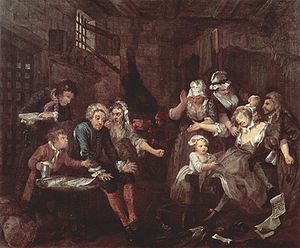
William Hogarth, A Rake's Progress (source)
One of the worst impacts of the new economy is the psychological impacts that permanent unemployment is having on individuals. Feelings of valuelessness, depression, disillusionment....

People need to know that, when they can't find employment, this is not a reflection on themselves personally. The Age of Growth is over; the Age of Contraction has begun. Jobs simply do not exist in the numbers they would have to to support greater employment.

Of course, work still needs to be done: just don't expect to be compensated for it in the traditional manner. This will remain a problem for as long as we rely on elements of the system — landlords, banks, grocery stores — that still require traditional remuneration for their services. This predicament points to a possible way forward, which is to take strides to limit one's exposure to the orthodox system, thus limiting one's requirements for money.

But that's a digression. The main point is that you should not take it personally if you can't find work. For one thing, you are not alone — in Pennsylvania, in May, payroll surveys estimated that 14,000 people were laid off or fired. The official unemployment rate also dropped by one-tenth of one percent, which is interesting. We've entered a bizarro realm where more people can be unemployed while the "unemployment" rate yet falls. This is thanks to statistical manipulations (in place for a few decades) that won't count you as part of the labor force if you've given up looking for work (12,000 people were kicked out of the labor force in May) — or count you as "employed" even if your new job is part-time and pays half or less what you once made.

I think it's a damn shame that highly-skilled, -talented, and -educated people should be made to feel like shit because our unsustainable, perpetual-bubble economy is hemorrhaging  jobs as it deflates. It's even worse that they were sold a bogus bill of goods when they (we) were still in high school: that school debt was "good debt", that digging ourselves into this financial hole was a good thing because it meant we'd make way more than if we didn't. They didn't bother to tell us that what this really meant was that we'd have to make way more than if we didn't go to college, because that would be the only way to fill in the gaping chasm that would become of our finances for the foreseeable future. It'll be interesting to see what happens when the College Bubble collapses.

Final word: this unemployment situation is permanent. It will get worse. Learn to make the best of it. You may as well default on your debt now, too, because you're never going to be able to pay it back, anyway. Best to get rid of it now, before they've reinstated debtors' prisons.